Observation-led history · Upper Cumberland
Stories Hidden in These Hills
Eight documented discoveries for exploring Black history across the Center Hill Lake region—from home or in the field, with evidence, reflection and respect.

Start here
Look. Learn. Follow the evidence.
You do not need to know where to begin. This hunt guides you from one real place to the people, records and questions that bring its history to life.
Begin your first mission ↓- 1Choose your setting
Explore from home or prepare for a respectful field visit.
- 2Notice before reading
Study a photograph and make your own observations first.
- 3Follow a learning path
Choose 20 minutes, 45 minutes or a field session.
- 4Save what you discover
Write notes, test evidence and take a question with you.
Your first mission · 3 minutes
What can one building reveal?
Look at the photograph for ten seconds. Then choose a clue. There are no trick questions—each answer shows how historians move from observation to evidence.
Continue to the photo archive →Choose how you are exploring
A field journal, not a scorecard.
There is no race, trivia score or claim of mastery here. Marking a discovery means you explored it thoughtfully; it does not mean the history is finished.
Four-part regional timeline
Build chronology before drawing conclusions.
- 01
1865–early 1900s
Emancipation and institution-building
Black Tennesseans built churches, schools, cemeteries, mutual-aid networks and civic institutions that made freedom usable in daily life despite segregation and violence. - 02
1886–1887; return in 1897
Du Bois’s Tennessee teaching years
As a Fisk student, W.E.B. Du Bois taught near Watertown and worshipped with the Seay Chapel congregation. His later return informed “Of the Meaning of Progress.” - 03
1912–1932
Rosenwald school-building era
Black communities, public systems and Rosenwald funding combined to build schools across the South. Community land, labor and money were central to the effort. - 04
Present day
Preservation and interpretation
Congregations, descendants, museums, archives and preservation partners continue to protect buildings, records and memory—and to correct incomplete public accounts.
Look closely
Four photographs. Four kinds of evidence.
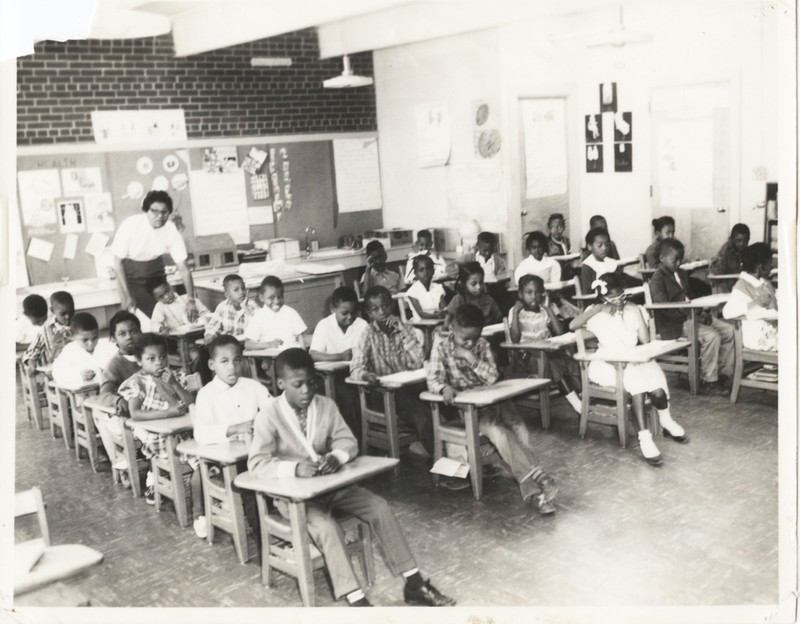
Open each photograph for the full caption and source. Notice who the archive names, what the camera includes and what remains outside the frame.
 123
123Photo detective
Read the room before reading the caption.
Spend thirty seconds with the classroom. Then compare three observations:
- People: The teacher and students—not the funder—are doing the work that gives the room meaning.
- Learning environment: Desks, books, displays and student work show how the room functioned, not merely how it was designed.
- Archive limits: The caption identifies the teacher but not every child. Ask what names were preserved and what names were lost.
Choose your depth
Build a learning path that fits the time.
Start with the timeline, Du Bois and one source check.
Read discoveries 01 and 02, open one photograph, then answer the first evidence scenario below.
Eight layered discoveries
Follow the place, the people and the evidence.
Showing 8 of 8 discoveries.
Alexandria · Seay Chapel and cemetery landscape
Begin with the institution built after emancipation
Overview
In 1869, land in Alexandria was conveyed for an African American cemetery, church and school. The site became an anchor for worship, education and civic life; the present chapel dates to 1931, after the earlier building burned.
Explore from Home
Compare the date of the congregation and site with the date of the building that survives. What changes when a place is older than its present structure?
Evidence and context
National Register documentation distinguishes the older congregation and community use from the 1931 building. That distinction prevents a surviving structure from being treated as the beginning of the story.
Reflection question
Why might a church, school and cemetery have been developed together in the first generation after emancipation?
Wilson County and Alexandria · Summers of 1886 and 1887
Follow Du Bois before fame
Overview
While studying at Fisk, eighteen-year-old W.E.B. Du Bois taught Black children at Wheeler School near Watertown and worshipped with the Seay Chapel congregation in Alexandria. The school no longer stands, but his writing preserves part of the encounter.
Explore from Home
Read “Of the Meaning of Progress” and identify one moment where Du Bois tests the idea of progress against a student’s lived experience.
Evidence and context
Du Bois’s published account, Tennessee historical scholarship and National Register records support different parts of the story. No single source does all the work.
Reflection question
How does knowing the names and ambitions of individual students change an abstract discussion of Reconstruction-era education?
Silver Point · West End Church of Christ
Find the school inside the church and publishing story
Overview
George Phillip Bowser established the Putnam County Normal and Industrial Orphanage in 1909; it became the Silver Point Christian Institute in 1913. Education, ministry, publishing and leadership belonged to one reinforcing network.
Explore from Home
Trace how one institution could prepare teachers and ministers while also supporting print culture and community leadership.
Evidence and context
The surviving church is physical evidence of the network, but it is not the entire institution. Published histories and church records are needed to reconnect the building to the school and Bowser’s work.
Reflection question
What becomes invisible when history focuses on famous individuals but not the institutions that trained and sustained people?
Free Hill, Clay County · Rosenwald school and community center
See a school within a living Black community
Overview
Free Hill was established as a Black community before the Civil War. Its Rosenwald school was built in 1929–1930 and later became a community center—evidence of education, self-determination and continued stewardship.
Explore from Home
Study an archival image of the school and list the building features that could be compared with other Rosenwald school plans.
Evidence and context
MTSU’s Center for Historic Preservation collection includes photographs and preservation records. These sources connect the structure to people who protected and reused it.
Reflection question
What does the building’s later use as a community center suggest about preservation as a social practice rather than a frozen display?
Tennessee and the rural South · 1912–1932
Read Rosenwald schools as a funding network—not a gift
Overview
The Rosenwald program helped communities build schools for Black children across the segregated South. Local Black residents contributed money, land and labor; public funds and Rosenwald support were combined rather than replacing community investment.
Explore from Home
Use the Library of Congress research guide to compare a school photograph, a building plan and a written record. What can each source show that the others cannot?
Evidence and context
Fund records, state databases, plans, photographs and community testimony can corroborate one another. A building style by itself is suggestive, not conclusive.
Reflection question
How does centering local contributions change the familiar story of Julius Rosenwald and Booker T. Washington?
Cookeville · West Side School / Darwin School legacy
Look for the local school behind a changed name
Overview
Cookeville’s Black education history includes West Side School, later known as Darwin School. Changing names, buildings and uses can scatter one institution’s record across museum exhibits, photographs, directories and oral histories.
Explore from Home
Search for both school names. Note which records describe a building, which describe students and teachers, and which describe later community memory.
Evidence and context
A museum label is an interpretation, not the entire archive. Follow its citations, dates, image credits and institutional names to the underlying records.
Reflection question
Whose work is easiest to recover in school records—and whose experience may survive only through family memory or oral history?
Center Hill region · Roads, reservoirs and vanished sites
Ask what a modern landscape has removed from view
Overview
Reservoir creation, road changes, migration, fire and redevelopment can erase buildings without erasing the communities that used them. Absence from a current map is not proof that a school, church or settlement never existed.
Explore from Home
Compare a historic map, census record or church history with a current map. Write down one question created by the mismatch.
Evidence and context
Maps answer where; census and institutional records help answer who; oral histories can explain meaning and change. Each source also carries omissions.
Reflection question
What responsibilities come with interpreting a place when the most visible evidence belongs to a later period?
Upper Cumberland · Archives, congregations and local stewards
Recognize preservation as present-day community work
Overview
History survives because people save photographs, maintain cemeteries, repair buildings, record elders, nominate sites and correct public accounts. Preservation is ongoing work, not the final chapter after history ends.
Explore from Home
Choose one historical claim from this page and follow it to the named archive or institution. Record what the source confirms and what remains unresolved.
Evidence and context
Community knowledge can correct institutional records; archives can preserve dates and documents beyond living memory. Responsible interpretation makes room for both and labels disagreement honestly.
Reflection question
Who should have authority when tourism, scholarship and community memory describe the same place differently?
Evidence decisions
What would you do next?
Historians rarely get perfect evidence. Choose the strongest next step, then see why it helps.
A building has tall windows and resembles a Rosenwald plan. Is that enough to call it a Rosenwald school?
Three-question source activity
Test one claim before repeating it.
Choose a marker, museum label, webpage, photograph or family account. Use these questions to separate documentation, interpretation and uncertainty.
Responses are stored locally in this browser and are not sent to Tony’s Guide.
Respectful-visit guidance
A meaningful visit never requires intrusion.
- Use public roads and confirmed public access. A map pin is not permission to enter.
- Treat churches and cemeteries as active sacred spaces, not unattended attractions.
- Do not interrupt services, funerals or community events; ask before photographing people.
- Never move objects, clean markers, make rubbings or disturb graves without authorization.
- Record uncertainty honestly. Submit local knowledge through Tony’s correction pathway rather than forcing a neat story.
Talk about what you found
One question for the ride home.
What is the difference between visiting a historic place and consuming it?
Sources and deeper reading
Continue beyond the discovery cards.
Tony’s Guide
W.E.B. Du Bois Walked These RoadsAfrican American Heritage Near Center Hill LakeFree Hills Rosenwald SchoolThe Land Before the LakeArchives and historical institutions
Library of Congress: Rosenwald Schools research guide ↗Tennessee Encyclopedia: W.E.B. Du Bois ↗Tennessee Historical Commission: National Register program ↗MTSU Center for Historic Preservation: Free Hills school record ↗MTSU Walker Library: African Americans in Tennessee research guide ↗Black history · Five distinct ways in
Continue with a different kind of experience.
Each guide has one job. Start with the format that fits your time, companions and questions; together they form a deeper collection without repeating the same trip.
Build a half-day or full-day itinerary →W.E.B. Du Bois Heritage Tour
A source-led journey from Fisk to Alexandria, built around Du Bois’s own words and the strength of the surviving evidence.
Best forResearchers, educators & a full or DeKalb-focused driveOpen experience →02Investigate the evidenceBlack History Discovery Hunt
An interactive, observation-led challenge that turns reading, noticing and reflection into eight meaningful discoveries.
Best forFamilies, students & exploring from home or in the fieldYou are here03Drive the wider storyAfrican American Heritage Route
A practical regional route connecting schools, churches, cemeteries, museums and Black institution-building across multiple counties.
Best forFirst-time visitors choosing a responsible half-day routeOpen experience →04Go deep on one placeFree Hills Rosenwald School
A place-based history of a living Black community and the school its residents helped build under segregation.
Best forPreservation, education history & a Clay County excursionOpen experience →05Understand the groundThe Land Before the Lake
The broad context: communities, work, displacement and memory beneath today’s recreation landscape, with Black history in its regional setting.
Best forOrientation before any heritage tripOpen experience →